
Why Blue Zones science is the missing piece for activist longevity
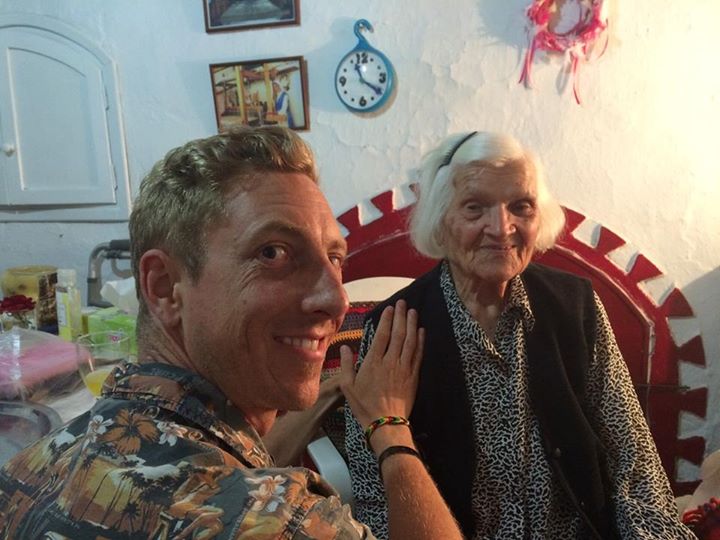
It was the summer of 2015, and my wife and I were on holiday in Ikaria, a small Greek island that had recently become famous as one of the world’s Blue Zones. These are places where people regularly live into their 90s and 100s in good health, leaving the rest of us behind in terms of longevity. We weren’t there to study centenarians or conduct research. We just fancied a quiet island holiday.
Then we met Ioanna.

Born in 1911, Ioanna was 105 years old when we knocked on her door. She was still sharp as a tack, though her body was starting to go on her. She walked with a zimmer frame, and her right shoulder had seized up after an accident two years earlier when she was 103. My wife speaks Greek, so she translated while I gave Ioanna a short Shiatsu treatment for her shoulder and neck pain. She hugely appreciated it and started calling me Dr. Simon, which made me laugh.
What struck me most wasn’t just that she’d lived to 105. It was that she’d kept working as a weaver right up until that age. She was still engaged with life, still passionate about the universe, still thinking about the cosmos late at night instead of sleeping. She had opinions, wit, and fire.
And she’d lived through both World Wars, the Greek Civil War, decades of political upheaval, and the modern erosion of traditional island life. She’d seen fascism rise and fall. She’d witnessed occupation, resistance, and survival.

Ioanna was, in her own quiet way, an activist for life itself.
What Ioanna Taught Me
Through my wife’s translation, Ioanna shared her philosophy on living long and well. Her advice came in three parts: outlook on life, diet, and whether young people today (anyone under 70, in her view) had a chance of reaching her age.
Her first gem: “It’s important to love the universe. The Universe is life.”
She told us she stayed awake at night thinking about the wonders of the cosmos. This wasn’t just idle stargazing. For Ioanna, this sense of wonder and connection to something bigger than herself was fundamental to her health and her ability to persevere through difficulties. It kept her here long after many friends and family had passed on.
Then came the social wisdom: “Don’t be jealous. Jealousy is what makes you ill. Be happy for other people’s success.” And critically, “When other people feel sad, feel sad too.”
This was about appropriate emotional connection. About staying connected to those around you rather than separating yourself through resentment or indifference. About community care, not isolation.
On money and possessions, she was blunt: “Don’t accumulate money. Life here is not about making more than you need. You can’t take it with you. Just have enough to live a happy, comfortable life.”
She was particularly concerned about young Greeks living off their parents, expecting others to provide for them. “Nobody owes you anything,” she said firmly. “You have to make your own life. It’s important to be independent and stand on your own two feet.”

Her diet was simple: mostly vegetables and fruits, a little fish and chicken, no red meat, olive oil on salads, no fried food. Figs and grapes grew right outside her front door. She had a light snack in the evening with weak milky coffee, a teaspoon of Ikarian honey each morning, and a little wine with water now and then.
Her best line about alcohol: “Drink wine if you can drink it, but not if it drinks you!”
When I asked if young people today could live as long as her, she said, “Why not?!” It wasn’t particularly amazing to her that she’d lived to 105. It was just her normal life. But I could see the most important factor was her attitude. She still enjoyed life, wanted to be here, and had never given up. She had what I’d call a will to live.
She also said you needed good relationships. Love. Not just romantic love, but love for others and love for the universe itself. Don’t be distracted by the grass always being greener. Work on what you have.

What This Has to Do With Activist Burnout
Fast forward to now. I’ve spent the last few years researching activist burnout and longevity science, and everything Ioanna taught me has come full circle.
Here’s the brutal truth: around 50% of burned-out activists leave movements permanently. Not temporarily. Forever.
Why? Because movement culture has a martyrdom problem. We’ve conflated burnout with commitment. Can’t make the meeting because you’re exhausted? You must not care enough. Need to step back? You’re abandoning the cause. Talking about your own wellbeing? That’s bourgeois self-indulgence.
This culture serves the systems we’re fighting against. When we burn out and leave, they win.
Standard wellness advice doesn’t help activists because it assumes you’re working a normal job with boundaries, that your stress comes from manageable personal challenges rather than systemic oppression, and that you can simply “turn off” from your identity and values.
Activists need something different. And that’s where Blue Zones science comes in.
The Blue Zones Advantage for Activists
Blue Zones research identified nine common factors among centenarians, called the Power 9:
- Move Naturally – activity built into daily life
- Purpose (Ikigai) – reason to wake up (worth 7 years of life expectancy)
- Down Shift – daily stress reduction rituals
- 80% Rule – stop eating at 80% full
- Plant Slant – mostly plant-based diet, beans as cornerstone
- Wine @ 5 – moderate alcohol with friends (connection matters more than the wine)
- Belong – strong community participation
- Loved Ones First – relationships prioritised
- Right Tribe – social circles supporting healthy behaviours
Here’s what activists typically nail:
- Purpose (you have this in abundance)
- Community (you’re part of movements)
- Plant-based eating (often aligned with values)
Here’s what you’re catastrophically neglecting:
- Down shift (doom-scrolling isn’t rest)
- Loved ones first (relationships sacrificed for activism)
- Move naturally (sedentary organising work)
- Right tribe (comrades may reinforce burnout culture)
- 80% rule (eating whatever, whenever, barely noticing)
Ioanna embodied all nine principles without trying. She moved naturally through her weaving work. She had profound purpose in her craft and her wonder at the universe. She managed stress through contemplation and connection. She ate simply and stopped when satisfied. Her diet was plant-forward with minimal meat. She enjoyed wine socially in moderation. She belonged to her island community. She prioritised relationships and advised against jealousy and resentment. Her tribe supported her values and health.
She didn’t achieve 105 years through biohacking protocols or expensive supplements. She achieved it through sustainable daily practices, maintained over decades.
This is exactly what activists need: not intensity, but sustainability.
But Wait, Aren’t Blue Zones Debunked?
You may have seen recent headlines claiming Blue Zones are based on “fake data” or pension fraud. A researcher named Saul Newman won an Ig Nobel Prize in 2024 for a paper arguing that exceptional longevity claims are actually due to poor record-keeping and fraudulent age reporting.
Let me be clear: this criticism is unfounded.
Newman’s paper is a pre-print that has not been peer-reviewed or published in any scientific journal, despite being submitted over four years ago. He’s a plant biologist with no training in demography, gerontology, or geriatrics.
More importantly, his criticism completely misses what Blue Zones researchers actually did. Dan Buettner and his team didn’t just crunch data from afar. They went to each Blue Zone location with demographers and scientists to validate ages on the ground. They used birth certificates cross-referenced with church baptism records and other local documentation. They examined town hall records dating back 120 years.
They also investigated other potential Blue Zones like Vilcabamba in Ecuador and Barbados but didn’t designate them as Blue Zones because the record-keeping was too unreliable. This rigorous validation process is exactly what separates actual Blue Zones from areas with questionable data.
Newman claims that poverty and lack of birth certificates predict extreme old age. But this ignores that Blue Zones researchers specifically required solid documentation as the first criterion. Ikaria has civil records. Okinawa has detailed Japanese government data. Sardinia has meticulous Italian registry systems. These aren’t places with missing paperwork.
Newman also points to modern Okinawa’s obesity rates and poor health indicators, claiming this contradicts Blue Zone findings. But Blue Zones research focused on elderly populations who grew up with traditional lifestyles. Modern younger Okinawans have adopted Western diets and sedentary habits, which is why their health is declining. This actually proves the Blue Zones point: when you abandon these sustainable practices, longevity suffers.
The criticism also comes largely from people promoting carnivore diets or those who conflate plant-based eating (predominantly plants but not excluding meat) with strict veganism. Their language tends toward ridicule rather than presenting counter-evidence.
Meanwhile, Blue Zones principles align perfectly with the broader scientific consensus on healthy ageing: regular movement, strong social connections, stress management, plant-forward diets, and sense of purpose. This isn’t controversial. It’s basic public health.

Foundation Before Optimisation
Here’s my approach as a longevity coach working specifically with activists: foundation first, optimisation later.
You don’t need to track your HRV, take 47 supplements, or follow complex biohacking protocols. You need the basics that Ioanna lived by:
- Adequate sleep (this is activism strategy, not luxury)
- Real food (fuel for sustained effort, not just convenience)
- Natural movement (built into daily life, not scheduled gym torture)
- Genuine rest (separate from activism, not just scrolling)
- Connected relationships (resilience during hard times)
This is longevity science adapted for activists. Not living longer just to live longer. Living healthier to fight longer.
As Audre Lorde said: “Caring for myself is not self-indulgence, it is self-preservation, and that is an act of political warfare.”
Ioanna taught me that longevity isn’t about pushing harder. It’s about living in balance, in community, with purpose and rest. She fought through two world wars, political upheaval, and personal losses. She kept weaving. She kept loving the universe. She kept going.
You can fight for 40+ years if you build the foundation to sustain it.
Your health isn’t a distraction from activism. It’s the infrastructure that makes decades of effective activism possible.
Not self-care. Sustained resistance.
Ready to build your foundation for sustainable activism?
Join my free Introduction to Activist Longevity workshop, where we explore how Blue Zones science applies specifically to activists and changemakers. Learn the practices that support decades of effective work, not just a few years of burnout. Find upcoming workshop dates here.