
How the Black Panther Party Created a Survival Strategy That Got Co-opted by the Wellness Industry
You’ve been lied to about self-care.
Bath bombs. Face masks. “Treat yourself.” Self-care has become synonymous with buying things and feeling guilty about taking time for yourself.
But that’s not where it started.
Self-care was created by the Black Panther Party in the 1960s and 70s as a survival strategy against systemic racism and medical discrimination. It was an act of political resistance. A refusal to let oppression destroy them before they could dismantle it.
Then the wellness industry stole it, stripped it of its radical roots, and sold it back to us as consumer products.
I think we should reclaim it.
The Actual History (Not the Instagram Version)
Before the Panthers: Medical Origins (1950s)
The term “self-care” first appeared in medical contexts in the 1950s, used to describe actions like personal grooming and exercise that institutionalised patients could take to practice autonomy and foster self-worth.
But it was purely clinical. Not political. Not yet.
The Black Panther Party: Making Self-Care Political (1960s-1970s)

Whilst the concept existed in medical communities, it was popularised and politicised by the Black Panther Party in the wake of their immense struggles against racism in America.
Why the Panthers Needed This
The Panthers were fighting systemic oppression through direct action—including dangerous and violent confrontations. This work was emotionally and physically taxing. To sustain their activism, they recognised that care and health support were necessary, not just for individuals, but for entire Black communities facing medical discrimination and lack of access to healthcare.
The Programmes They Created
In 1972, the Black Panther Party held the Black Community Survival Conference in Oakland, California: a rally, street fair, and block party featuring speeches and information about their free community-service programmes.
These nationwide clinics recruited nurses, doctors, and students to:
- Test for illnesses rampant in Black communities (lead poisoning, sickle-cell anaemia)
- Provide basic preventive care
- Challenge medical racism and discrimination
- Build health infrastructure when government systems failed them
The Ten-Point Program (1972)
The Panthers released their manifesto on healthcare:
“We want completely free healthcare for all Black and oppressed people…health facilities which will not only treat our illnesses, most of which have come about as a result of our oppression but which will also develop preventive medical programs to guarantee our future survival.”
— Black Panther Party Ten-Point Program, 1972
This wasn’t self-indulgence. This was survival.
Revolutionary Intercommunalism
The Panthers understood: In order to survive in this world, they had to take care of themselves and, inherently, one another.
Self-care was never individual. It was always collective. Always community care.
Angela Davis & Ericka Huggins: Self-Care Behind Bars

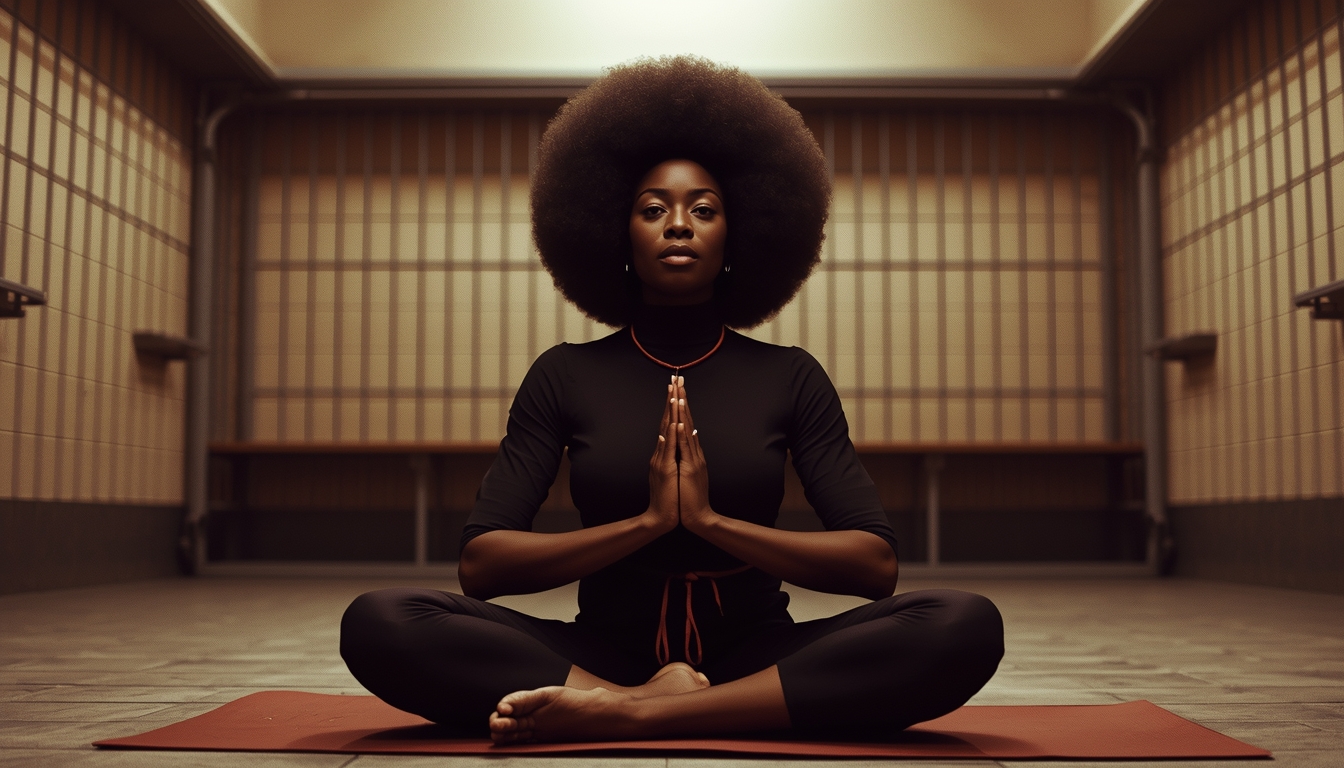
Angela Davis and Ericka Huggins, Black Panther leaders, practised yoga, mindfulness, and meditation whilst incarcerated, not as luxury wellness routines, but as acts of survival and resistance.
Angela Davis on radical self-care:
“Practicing radical self-care means we’re able to bring our entire selves into the movement. It means we incorporate into our work as activists ways of acknowledging and hopefully moving beyond trauma. It means a holistic approach.”
— Angela Y. Davis
And the critical warning:
“If we don’t start practicing collective self-care now, there’s no way to imagine, much less reach, a time of freedom.”
— Angela Davis
Davis recognised what many activists still struggle with:
“For a long time, activists did not necessarily think that it mattered to take care of themselves in terms of what they eat, mental self-care, cultural self-care, spiritual self-care.”
— Angela Davis, 2018 AFROPUNK interview
The Panthers knew: Burned-out activists can’t fight. Healthy activists sustain movements.
Audre Lorde: Self-Care as Political Warfare (1970s-1980s)

Audre Lorde adopted these philosophies and expanded on self-care in her essays. As a Black, lesbian mother, warrior and poet, she most notably explored these ideas in her 1988 book A Burst of Light, written whilst battling cancer, racism, sexism, and homophobia simultaneously.
The quote that changed everything:
“Caring for myself is not self-indulgence, it is self-preservation, and that is an act of political warfare.”
— Audre Lorde, A Burst of Light: And Other Essays
Lorde understood: For marginalised people and activists, staying alive and healthy is itself resistance.
This quote became a rallying cry—particularly for Black women who are often pillars of their communities, tasked with taking care of everyone else whilst neglecting themselves.
The Women’s Liberation Movement Connection
The Women’s Movement took cues from the Civil Rights Movement, especially around healthcare.
The problem: Sexism was rampant in the medical field. Female bodies were perceived as “inherently sick” (if middle/upper class) or as a “vector of disease” (if poor/working class). Medical staff were hostile toward women’s reproductive rights.
The response: Women’s liberation activists opened their own clinics designed specifically for women’s needs—mirroring the Panthers’ community health approach.
Self-care became feminist praxis. Healthcare became political action.
What Got Lost: Co-optation & Commercialisation (1980s-Present)

By the 1980s, the Black Panthers and many of their successful community programmes had been destroyed by government interference, infighting, and systematic suppression.
Fitness and wellness lifestyles began moving from the fringes to the mainstream, becoming commercialised and associated with the wealthy. Yoga classes appeared in health clubs. “Wellness” became a product to sell.
What self-care became:
- Bath bombs and face masks
- Buying things as “self-care”
- Individual consumerism masquerading as health
- $4.5 trillion wellness industry erasing Black radical origins
What got obscured:
- Community care over individual self-care
- Health as political infrastructure
- Survival as resistance
- Collective action for sustained activism
Why This History Matters for Activist Longevity
This isn’t just an interesting backstory. This validates everything I teach.
1. Community Care Over Individual Self-Care
The Panthers never promoted selfish individualism. They built community programmes—free clinics, health education, collective support.
My work returns to this: Your health isn’t separate from your activism. Your well-being supports your movement. Sustainable health enables sustained resistance.
2. Health as Activism Infrastructure
The Panthers understood: You cannot fight oppression if you’re dead or incapacitated.
My positioning:
Your health isn’t a distraction from activism; it’s the foundation that makes decades of effective activism possible.
When you’re healthy, you:
- Show up more consistently for your communities
- Make better strategic decisions (exhaustion makes terrible strategy)
- Model sustainable activism for younger activists
- Stay in the fight for decades, not just years
- Build institutional knowledge that movements desperately need
When you burn out and leave permanently (which 50% of activists do), your community loses decades of potential impact.
The oppressors win when we exhaust ourselves.
3. Accessible, Practical Approaches
The Panthers didn’t promote expensive wellness products or elite biohacking protocols. They provided:
- Free health clinics
- Community meals
- Basic preventive care
- Education and resources
My approach: Foundation before optimisation.
You don’t need expensive supplements or elaborate routines. You need:
- Adequate sleep (activism strategy, not luxury)
- Real food (fuel for sustained effort)
- Natural movement (built into daily life)
- Genuine rest (separate from doom-scrolling)
- Connected relationships (resilience during hard times)
4. Collective Wellbeing for Sustained Activism
The Panthers knew movements needed people for the long haul, not just for one protest, one campaign, one crisis.
Around 50% of burned-out activists leave movements permanently.
Not temporarily. Forever.
When experienced activists burn out, movements lose:
- Skills and expertise
- Institutional knowledge built over years
- Networks and relationships
- Unique perspectives and voices
- Decades of potential impact
Self-care as the Panthers taught it: Keeping yourself healthy enough to sustain 40+ years of activism.
5. “Foundation Before Optimisation” = Blue Zones Wisdom
The Panthers’ approach mirrors what Blue Zones research reveals: People who live healthy past 100 don’t achieve longevity through intensity; they achieve it through sustainable daily practices.
Not biohacking. Not optimisation. Foundation.
- Natural movement
- Community meals
- Stress reduction
- Purpose
- Strong relationships
This is the longevity approach activists need.
Not living longer just to live longer.
Living healthier to fight longer.
Reclaiming Self-Care: What It Actually Means
Not This:
❌ Bath bombs and bubble baths
❌ Individual self-indulgence
❌ Buying wellness products
❌ “Self-care Sundays” as guilt management
❌ Consumerism masquerading as health
But This:
✅ Community care frameworks
✅ Health as activism infrastructure
✅ Collective action for sustained resistance
✅ Accessible, practical strategies
✅ Survival as a political act
✅ Building foundation for decades of activism
Audre Lorde Was Right
“Caring for myself is not self-indulgence, it is self-preservation, and that is an act of political warfare.”
Audre Lorde wasn’t speaking abstractly. She was fighting racism, sexism, homophobia, and cancer simultaneously. She knew that staying alive and healthy was itself an act of resistance.
Your health is political.
Taking care of yourself isn’t selling out or abandoning the struggle.
It’s refusing to let the systems you’re fighting destroy you before you can destroy them.
My Work: Continuing the Legacy
As a white longevity coach, I don’t claim this work as my own. And it’s not an opportunity to mansplain things to you either.
I’m returning to these radical roots, honouring and continuing the work begun by the Black Panther Party, Angela Davis, Audre Lorde, and countless Black feminist and civil rights activists.
I combine:
- The Panthers’ community care framework
- Angela Davis’s collective self-care approach
- Audre Lorde’s recognition of health as political warfare
- Blue Zones longevity science (sustainable daily practices)
- Activist burnout research (the Four Root Causes)
To help progressive activists, changemakers, and equity advocates:
- Build physical resilience for sustained activism
- Challenge martyrdom culture explicitly
- Create community care frameworks
- Apply longevity science to activist reality
- Recognise health as strategic resistance
Not Self-Care. Sustained Resistance.
50% of activists burn out and leave permanently.
The systems we’re fighting WIN when we exhaust ourselves.
Activist longevity isn’t self-indulgence.
It’s strategy.
Outliving the bastards is an act of resistance.
Further Learning
Want to understand this history more deeply?
- Audre Lorde: A Burst of Light: And Other Essays (1988)
- Alondra Nelson: Body and Soul: The Black Panther Party and the Fight Against Medical Discrimination (2011)
- Angela Davis: Interviewsand writings on radical self-care
- The Black Panther Party: Ten-Point Program (1972)
Modern applications:
Ready to Reclaim Radical Self-Care?
Start with my free workshop:
Outliving the Bastards: Activist Longevity and Avoiding Burnout
Or explore:
- My Approach – How I combine Blue Zones + Activist Burnout Research
- Why Activists Burn Out – The Four Root Causes (backed by research)
- Work With Me – Foundation to Longevity Programme
Lib Long and Prosper 🖖
Simon Henderson, The Liberal Longevity Coach
Credits & Acknowledgments
This page honours the intellectual labour and radical activism of:
- The Black Panther Party (1966-1982)
- Angela Y. Davis – Black Panther leader, scholar, activist
- Ericka Huggins – Black Panther leader
- Audre Lorde (1934-1992) – Black lesbian feminist writer and activist
- The Women’s Liberation Movement health activists
- All Black feminist and civil rights activists who created the framework of self-care as political resistance

Their work made mine possible.