
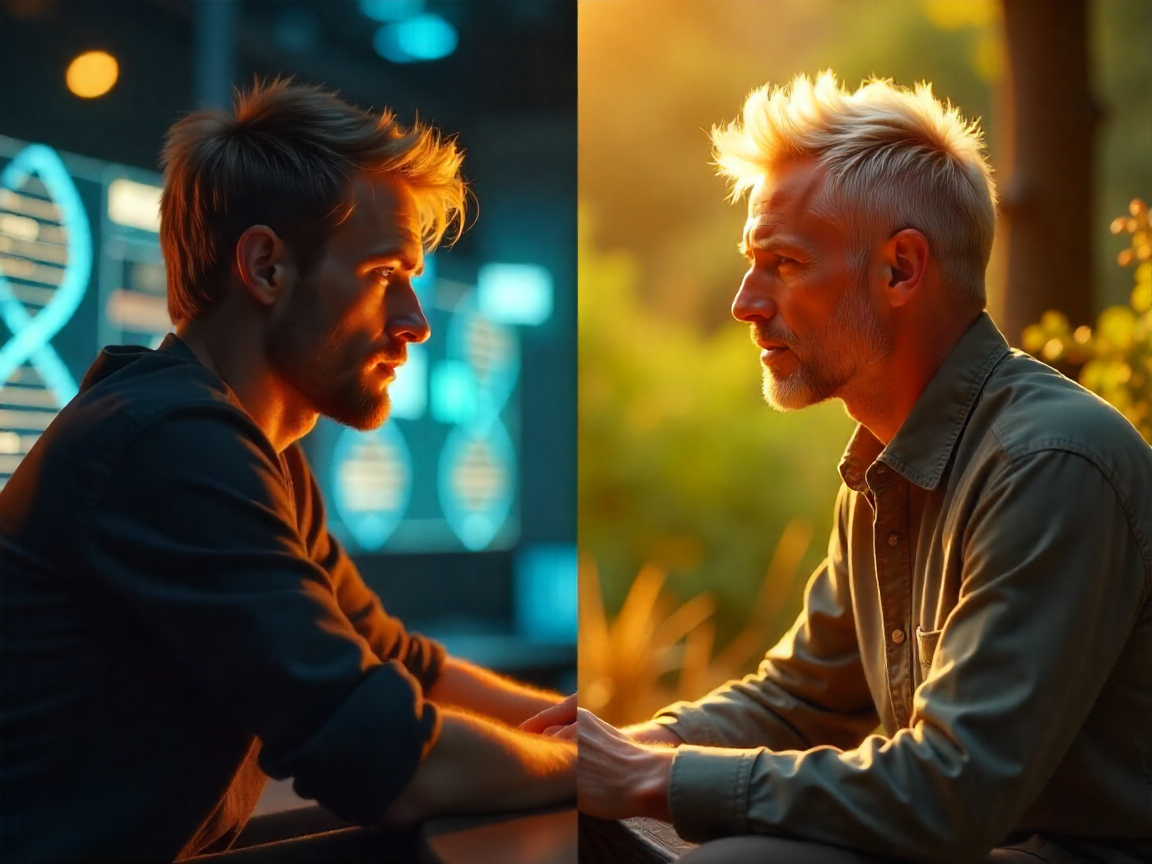
What I got right, what I got wrong, and how my perspective on life extension has completely transformed
I recently came across some old writing from 2012, when I ran a website called “The Life Extension Project.” Reading it was… enlightening. And a bit embarrassing.
At 35, I was passionate about longevity science but hadn’t yet developed the more nuanced understanding I have now. I was also writing from a completely different worldview, one focused on individual optimisation rather than social justice, technology over wisdom, and escape from the world rather than engagement with it.
Thirteen years later, as The Liberal Longevity Coach, my approach has undergone a fundamental shift. Let me walk you through what I got right, what I got spectacularly wrong, and how my thinking has evolved.

What I Got Right (Give Me Some Credit)
Looking back, some of my 2012 predictions were pretty spot on:
Technology Democratisation
I wrote about how expensive life extension technologies would “initially just be for the rich; the wealthy celebrities and multibillionaire business tycoons, but over time the cost of this technology will come down significantly.” This pattern has held true. We’ve seen it with everything from genetic testing to continuous glucose monitors.
The Importance of Exercise
My emphasis on weight-bearing exercise for bone density and muscle mass was solid. I wrote: “As we age, particularly over the age of 40, the body doesn’t maintain the same amount of muscle mass but automatically starts to atrophy when not regularly used.” This understanding of sarcopenia was ahead of mainstream awareness.
Individual Variation
Even then, I recognised that “everyone is different” and needed personalised approaches. This individual variation principle remains central to my current work.
The Intersection of Multiple Fields
I predicted longevity breakthroughs would come “through various fields: science, medicine, nutrition, exercise, psychology and spirituality.” While I’ve shifted away from some spiritual frameworks, the interdisciplinary approach was correct.
What I Got Spectacularly Wrong
Overly Optimistic Timelines
Oh, how wrong I was about timing. I predicted that “within the next 20 to 40 years we may be able to stop ageing as we know it, preserve our bodies in a youthful condition and for those who are already older, maybe to return them to a former state of health and vitality.”
We’re now 13 years into that timeline, and while longevity science has advanced significantly, we’re nowhere near “stopping ageing as we know it.” I underestimated the complexity of biological systems and overestimated the speed of translation from research to application.
Nanotechnology Hype
I was convinced nanotechnology would “enter into mainstream consumer society” within 15 years. While we’ve made progress, the medical nanotechnology revolution I envisioned hasn’t materialised in the consumer space.
Technology-First Approach
My 2012 self was obsessed with technological solutions like organ printing, nanotechnology, and hormone replacement. I barely mentioned nutrition, sleep, stress management, or the basic lifestyle factors that actually move the needle on longevity.
Philosophical Blind Spots
I spent considerable time critiquing traditional religions for being “escape-focused” while proposing my own escape-focused philosophy centred on “evolutionary cosmology.” The irony was lost on me at the time.
The Science I Missed
While the website was never finished, when reading my old work, I’m struck by what wasn’t there:
Cellular Senescence
No mention of zombie cells or the role of senescent cell accumulation in ageing.
Autophagy
Missing entirely, despite this being crucial for cellular cleanup and longevity, even though I was and am an advocate for fasting and other detoxes.
Inflammation
I didn’t understand chronic inflammation as a driver of ageing and age-related disease.
Blue Zones
No awareness of the longest-living populations on Earth and what we could learn from them. Although not long after writing that material, I visited the Greek Blue Zone of Ikaria and met a 104-year-old called Ioanna.

Metabolic Health
Limited understanding of insulin resistance, metabolic syndrome, and their role in healthspan.
Stress and Longevity
Minimal discussion of how chronic stress accelerates ageing processes.
The science has exploded in these areas since 2012, fundamentally changing how we understand ageing mechanisms. At the time, my understanding was incomplete, but so was the science.
The Values Revolution
The biggest change isn’t scientific – it’s political and philosophical.
2012 Me: Focused entirely on individual optimisation. Life extension was about personal enhancement, cosmic evolution, and technological transcendence.
2025 Me: Understands that longevity is social and political. I’m angry about billionaires hoarding life extension technologies while their corporations poison our environment. I see staying healthy as an act of resistance.
What Changed?
Around 2016 (I wonder why?), I had a political awakening. I realised that personal health doesn’t exist in a vacuum. The people working hardest to make the world better, like activists, journalists, and environmentalists, were in danger of burning out and breaking down just when we needed them most.
This led to my “sustainable activism” framework: helping change-makers stay healthy so they can continue fighting for justice. Your health isn’t separate from your values.
My Current Approach: Foundation Before Optimisation
My 2012 approach was backwards. I was obsessed with cutting-edge interventions while ignoring the basics.
Then: Technology first, foundation later
Now: Foundation first, optimisation later
As I often say: You can’t just take pills and expect to live forever. You can’t just eat salad and do yoga. You need to build a solid base of ethics and philosophy, promote good health, deal with damaging behaviours and limiting beliefs, then add longevity interventions, biohacks, and supplements on top.
The Foundation
- Quality sleep (7-9 hours consistently)
- Nutrient-dense, minimally processed food
- Regular mobility, flexibility and strength training
- Stress management that works in the real world
- Social connections and community
- Purpose and meaning
The Optimisation (only after the foundation is solid)
- Strategic supplementation
- Advanced testing and biomarkers
- Targeted interventions based on individual needs
- Emerging longevity technologies
- Discover your Ikigai and work towards self-mastery
What I’ve Learned from Actually Helping People
Theory is one thing. Practice is another.
After working as a shiatsu therapist for over a decade and now as a longevity coach, I’ve learned that:
People Need Individual Solutions
What works for a 30-year-old Silicon Valley tech worker won’t work for a 45-year-old activist parent juggling work, family, and saving democracy.
Natural Solutions Often Work Better
Plant-based interventions like ginseng for energy or berberine for blood sugar often work as well as pharmaceuticals with fewer side effects.
Compliance Beats Perfection
A good plan you’ll actually follow beats a perfect plan you’ll abandon in three weeks.
Community Matters
The Blue Zones taught us that social connections are as important as diet and exercise for longevity.
Values Alignment is Crucial
Health strategies that conflict with your values won’t stick. Progressive activists need approaches that align with their worldview.
Where I Stand Now
I’m no longer chasing technological immortality. I’m focused on helping good people stay healthy enough to do good work in the world.
The Goal
Not living forever, but living well for as long as possible while making a positive impact.
The Method
Evidence-based strategies that are accessible, sustainable, and aligned with progressive values.
The Why
Because the world needs activists, journalists, environmentalists, and change-makers who can sustain their work for decades instead of risking burning out in a few years.

What Hasn’t Changed
Despite all this evolution, one thing remains constant: I still believe longevity science offers incredible potential for improving human health and extending healthy lifespan.
The difference is my approach. Instead of waiting for technological salvation, I’m focused on what we can do right now with the knowledge and tools we have.
And instead of pursuing longevity for its own sake, I see it as a tool for social justice, helping the resistance stay healthy for the long fight ahead.
The Bottom Line
My 2012 self was enthusiastic but naive. I overestimated technology, underestimated biology, and completely missed the social and political dimensions of health and longevity.
My 2025 self is more realistic about timelines, more grounded in evidence, and more focused on practical strategies that work for real people in the real world.
But most importantly, I now understand that longevity isn’t just about living longer, it’s about having the time and energy to make the world better.
Because we need to outlive the bastards!
Want to explore a values-aligned approach to longevity? Check out my Foundation to Longevity course or attend a free Introduction to Longevity workshop. Because your health is too important to leave to chance, and the world needs you healthy for what’s coming.